This is Our Wake-Up Call

By Steve Freedman
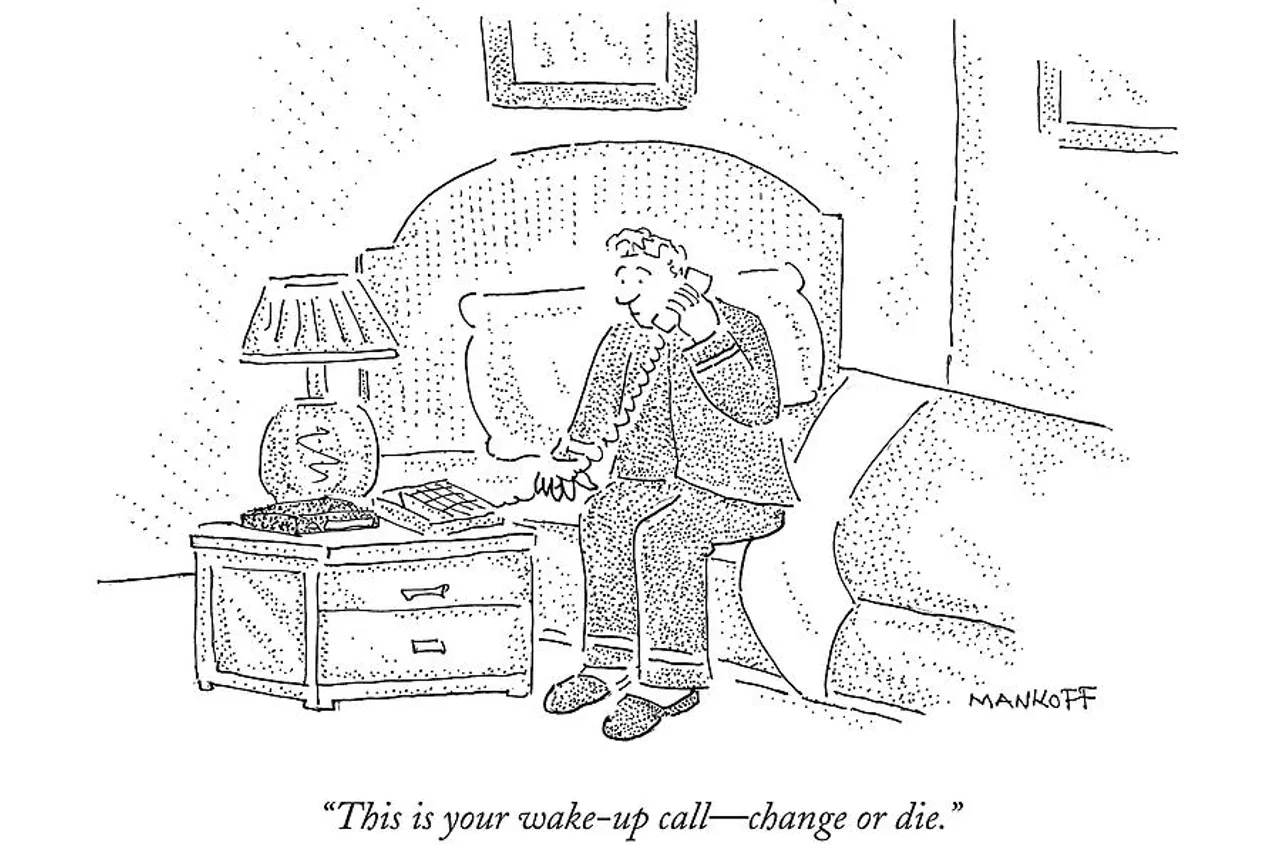
This New Yorker cartoon puts it plainly: change, or be left behind; change, or become irrelevant! In the world of education, more than ever, many parents, politicians and educators need to “wake up” to the changes that are essential for our children to learn in today’s world.
It is well-known that educational institutions are among the hardest to change – and it isn’t because of the bricks and mortar. It is because districts and governments are notoriously slow to change, and it is also because a school’s “customers” are its parents – and parents are always emotional about their children. In theory, people may like the idea of change, until it has to be embraced. Then fear of the unknown surfaces, causing feelings of stress and uncertainty, and even a lack of trust.
Imagine, however, a world in which concerns and fears prevented the leap of faith or the risk that was necessary to improve or advance humanity. Would we still be riding around in carriages? Or driving a 1955 Dodge? Or using candles instead of electricity?
I graduated high school in 1977. By 1987 the world was different; even more so in 1997. By 2007, the world had changed exponentially. And yet, in 2017 and today, most schools still look and behave like the school I attended in 1977. Schools haven’t changed, though the world is completely different! There has been more change in the past 40 years than in much of the 20th century – and that seemed like a century of great change. Many predict that the rate of change will continue to increase into the next several decades.
Among the improvements in the 21st century is a greater understanding among neuroscientists of how the brain works and learns. This understanding should help inform how schools set the conditions for deep learning. Learning is a complex process not well suited for cookie-cutter environments. We know the toll that too much pressure on meaningless tasks has on our children. In a connected world, our children are keenly aware of the time wasted in schools memorizing information in schools, and handling tasks in a standardized fashion. More than ever, students are turned off to school, and more suffer from depression and anxiety, often connected to the school experience.
I understand that school as we know it worked for many of us. We survived the standardized tests, the multiple choice tests, the excessive homework assignments, and worksheets. We endured the passive learning, the one-size-fits-all instruction, and the busy work. It was good enough in a world that was standardized and more predictable. That world, however, no longer exists. Horses got us to where we were going, candles lit homes, ether put us to sleep for surgery – and none of that is good enough for today.
And yet, this logic is still being applied to most schools. Policy makers, and too many parents, find comfort in the familiar – standardized testing for rankings and achievement, copious amounts of homework as the measure of hard work and learning, memorization of facts and information neatly regurgitated on tests or uniform projects and papers. When our children have homework, textbooks, tests, and worksheets – there is comfort in the familiar.
Schools in America are not adapting at the rate they must for our children to be ready for the world they will inherit. Other countries are making meaningful changes, and the impact is significant. Finland is most often cited, but Singapore is right there, too. Japan has been making the changes needed for today’s students, as are other countries in Europe. America is moving painfully slow, and still, too often, down the wrong path.
The research and data are readily available; we know how kids learn today better than ever before. We know the environments and conditions that are conducive to deeper, authentic and lasting learning. We know what our kids lack today because we hear it almost every day from universities and CEOs.
There is a lot that needs to happen, and it begins with embracing real, systemic change in our educational system. Similarly, parents and policy makers must adopt a growth mindset when it comes to our schools, and learning, the same growth mindset we teach our students at Schechter. We are on the change journey. Proudly, Schechter has made strides and we know that we have a distance to go.
Ready to get started? Watch this TEDx talk by Will Richardson, from Modern Learners; it’s a great overview concerning why schools must change. Also, this video “I Sued the School System” by the poet, speaker, and activist, Prince EA, who delivers a powerful message about the schools that are failing our children.
I look forward to having these conversations with the Schechter community and facilitating meaningful changes as we create a more modern and even more engaging learning environment that promotes inquiry-driven learning experiences for students that are fueled by curiosity, deep and meaningful learning, creativity, and successful skill acquisition.

Schechter Bergen admits students of any race, color, national and ethnic origin to all the rights, privileges, programs, and activities generally accorded or made available to students at the school. Schechter Bergen does not discriminate on the basis of race, color, national and ethnic origin in administration of our educational policies, admissions policies, scholarship and loan programs, and athletic and other school-administered programs.