
Reflections from Israel - Blog #3

By Steve Freedman
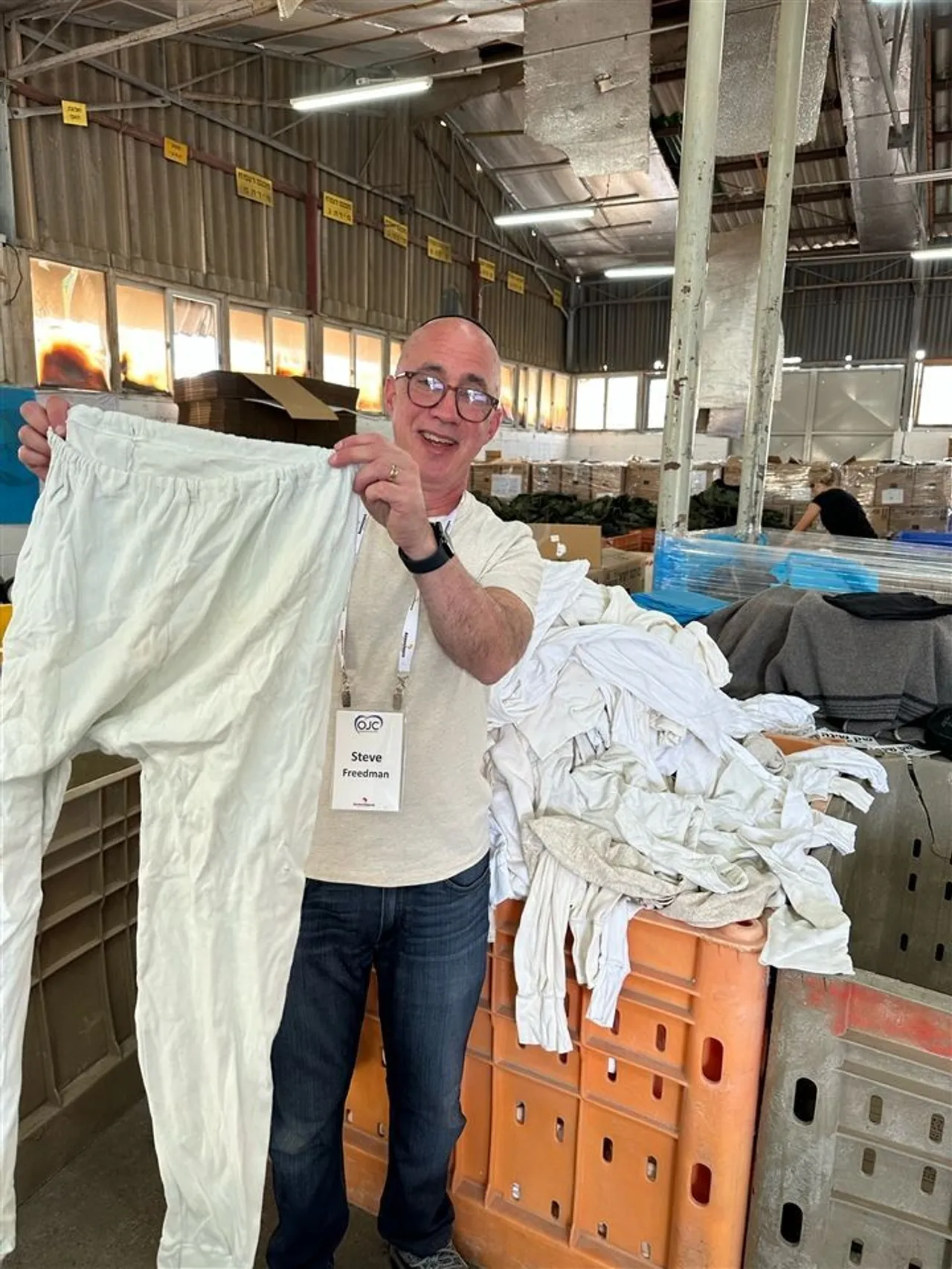
Today we had an early breakfast and headed to a very large military base about one hour outside of Jerusalem. Being on the base felt like we were in a small city. When we arrived, our guides took us to large warehouses where we would spend the next seven hours doing some of the most purposeful volunteer work I have ever engaged in.
Since the war began, there has been a terrible shortage of protective vests. Many of our soldiers have been fighting without this essential gear. The IDF is now working tirelessly to solve this problem, and today we played a small part. For most of the day our task was to put ceramic protective shields in the front and back of soldiers’ vests. The reservist running the operation showed us how to properly put the vests together and then we formed teams. We placed letters and cards, written by students in New York and New Jersey in many of the vests. Some of the volunteers put the shields in vests, others did quality tests, while still others packed them in boxes. We had many IDF soldiers working alongside our group. It was a lot of physical labor and also sobering to know that soldiers would soon be wearing these vests for their protection. This fact alone made the job of placing the shields stressful because if we placed the shields incorrectly, it could truly be a matter of life or death. It felt like such important work and we had the privilege to participate. In total we placed over 800 shields in vests and packed them - ready to go to the troops tomorrow.
There were other tasks that needed to be done as well. The nights are now cold and it is important that each soldier has warm clothes. We sorted long underwear that was donated and cleaned. Our supervisor was very particular. The garments could only be pure white with no stains. There were thousands to sort through and we managed to get through all of them.
We also had to inspect, and then zip and roll sleeping bags that were going back to the troops. We must have rolled a few hundred of them.
Everything we did today was for soldiers in combat. As I held a vest or folded underwear, or inspected and rolled a sleeping bag, I could not help but to imagine the individuals who would be using these items. Whose son or daughter? Whose Aba or Ima, or grandchild, wife or husband? Precious souls, defending Israel - people who love and are loved, risking their lives. I will never meet them, but I do feel like I know them. I pray we all did our part to keep them safe and to keep them warm.
These warehouses were filled with activity as endless rows of skids filled with boxes of vests and other supplies were ready to go as a result of ours and others' hard work. When I allowed myself to fully comprehend we were in the middle of a full-fledged war effort, doing our part as civilian volunteers to get much needed supplies to the troops in combat, it became a surreal experience. I could not possibly have imagined ever doing this prior to October 7.
We returned to the hotel very late in the afternoon. At dinner Taly Levanon, CEO of the Israel Trauma Coalition spoke. She focused on how to find resilience in a time when the world has changed forever in Israel. She spoke to us about the challenges of finding words and how other words will mean something different now, words like “home” and “feeling safe at home.” It is still a very raw time and everyone is just trying to get through, one day at a time.
As if to reinforce the words of Taly, at dinner we met Racheli, a survivor of the attack who shared her harrowing story. She was trapped in a safe room for over 12 hours with her three year old grandson, her son, and partner. Like Amir from the other night, the constant sounds of missiles told them this situation was different. Her kibbutz was lucky though, as the guards and other members of the kibbutz were able to prevent the terrorists from penetrating their kibbutz. The most frightening aspect of their ordeal was escaping the kibbutz. When it seemed safe enough, they got in the car and just drove. As they left the kibbutz bodies were all over the road and she had to swerve to avoid them. Throughout her escape she had one thought in mind, to get her family away from the kibbutz, especially since her daughter-in-law was in America expecting a child. She had to get her son and grandchild back home.
Now, just as Taly had stated, the word "home" meant something different. The home that Racheli loved, the place she felt safe, where she loved having her coffee in the garden in the most beautiful place on earth, that home - now, she may never return.

Schechter Bergen admits students of any race, color, national and ethnic origin to all the rights, privileges, programs, and activities generally accorded or made available to students at the school. Schechter Bergen does not discriminate on the basis of race, color, national and ethnic origin in administration of our educational policies, admissions policies, scholarship and loan programs, and athletic and other school-administered programs.